Skip Navigation College of Education Home Departments Programs & Credentials Offices Centers & More COE Directory
Latino Education and Advocacy Days (LEAD): Monday March 28, 2011 College of Education

LEAD Summit

Latino Education & Advocacy Days (LEAD)
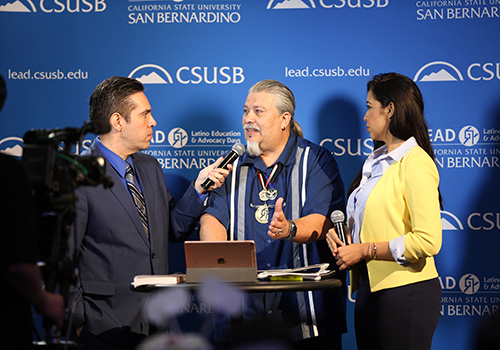
2nd Annual Summit

Monday, March 28, 2011
Santos Manuel Student Union

Official LEAD Program

LEAD Summit Live Global Webcast

(courtesy of LatinoGraduate.net)
(only available March 28, 2011 or later)


LEAD Summit Program
At-A-Glance:

7:30 AM: Check-In  - Live Mariachi Music

8:20 AM: Opening Video


8:30 AM: Welcome and Opening Remarks


9:30 AM: Morning Keynote Address - "Enhancing Education in America, the Economic

Imperative and Civil Rights Issue of our Generation"

10:10 AM: Break / “Un Cafecito”


10:25 AM: Forum – “Building Capacity and Ensuring the Next Generation of College Graduates”


11:25 AM: Presentation – “Under Cultural Assault / Apartheid in Arizona”


12:00 PM: Lunch / Aztec Dancers

1:00 PM: Video Message - "LEAD & Labor"

1:15 PM: Guest Speaker - “College Education for the Youth Development and Opportunity Pipeline”


1:30 PM: Afternoon Keynote Address: "Educational Leadership & Commitment: Addressing the Academic Challenges of Latino Students"


2:00 PM: Forum – “STEM, Workforce Development, and Economic Vitality”


2:55 PM: Break / “Otro Cafecito”


3:05 PM: Panel Discussion - “It Takes a Reform-Minded Learning Village: Meaningful

Interaction among Parents, Teachers, Unions and Administrators”


4:00 PM: Forum – “From Capitol to Campus / Obama Officials’ Call to Action”


5:00 PM: Acknowledgements


5:15 PM: Networking Reception / Live Mariachi Music
- Appetizers and Refreshments


7:00 PM: Capstone Event: "The Moment is Now: The President, Hispanics and Education"


Program Detail


Dr. Enrique Murillo, Jr.Master of Ceremony
Dr. Enrique G. Murillo, Jr.
LEAD Executive Director
California State University, San Bernardino


7:30 AM: Check-In

Continental Breakfast, Distribution of Packets, Optional Credit Registration, Live Music Entertainment - Featuring "Mariachi Aguilas de Oro"


8:20 AM: Opening Video

"Critical Voices II"

Taylor Vermillion
LEAD Videographer


8:30 AM: Welcome and Opening Remarks

James RamosChairman James Ramos
San Manuel Band of Mission Indians
Opening Bird Song


Charles B. ReedChancellor Charles B. Reed
The California State University


Albert K. KarnigPresident Albert K. Karnig
California State University, San Bernardino


Judy R. WatsonJudy Rodriguez Watson
2011 LEAD Honorary Chair/Madrina de Honor
Co-President, Watson and Associates Development


9:30 AM: Morning Keynote Address - "Enhancing Education in America, the Economic Imperative and Civil Rights Issue of our Generation"

 VIdeo: "CSUSB Hispanic Serving Institution"
             Academic Computing & Media


Jay FieneIntroduction / Moderator:
Dr. Jay Fiene
Interim Dean, College of Education
California State University, San Bernardino


Honorable Arne DuncanSpeaker:
Honorable Arne Duncan
U.S. Secretary of Education


10:10 AM: Break / “Un Cafecito”


10:25 AM: Forum – “Building Capacity and Ensuring the Next Generation of College Graduates”

Higher education practices and policies have often narrowly focused on college access more than college completion itself. This, together with the Obama Administration’s recent aims to re-establish the United States among the top ranking nations for college degree attainment by 2020, have led for a pursuit for solutions and policy changes that will help improve completion rates over the next decade.

While there may be a difference of judgment about the various pathways, there is agreement that our success in attaining these national college completion goals will be determined by how well we serve our Latino population. That is, the data is abundantly unambiguous that raising the outcome rates among United States’ growing Latino population is crucial, given that the current pace of degree completion is not sufficient.

Serving the Latino population means more than just enrolling them in colleges and universities, but more importantly improving the chances that they will complete a degree and get us to our national goal.

Why are some institutions more successful than others in helping Latino students with similar academic backgrounds earn degrees? Can we identify particular obstacles Latino students face in completing a college degree? Finally, how do we build the capacity and interagency collaboration so as to maximize the specific conditions that seem to positively affect graduation rates for our biggest and fastest growing population, and discuss the actions that can be taken to improve them?


Gustavo ChamorroIntroduction:
Gustavo Chamorro
Director, Digital Media Center
Rancho Santiago Community College District
and Doctoral Candidate, Educational Leadership Program, CSUSB


Michele SiqueirosMichele Siqueiros
Executive Director
The Campaign for College Opportunity


Louis OlivasDr. Louis Olivas
President
American Association of Hispanics in Higher Education


Monte PerezDr. Monte E. Perez
President
Moreno Valley College


Jorge HaynesModerator:
Jorge Haynes
Senior Director, External Relations
The California State University, Office of the Chancellor


11:25 AM: Presentation – “Under Cultural Assault / Apartheid in Arizona”

As the current epicenter of the anti-immigrant movement, groups of educators, students, workers, organizers and immigration activists who live in Arizona, are fighting against policies, practices, and repressive legislation.

The three legs of this Arizona trilogy include:
- SB 1070, the state’s racial profiling bill;
- HB 2281, the anti-Ethnic/Raza Studies bill; and
- Nullification of the 14th Amendment or Birthright Citizenship.

This presentation serves to offer organizers/educators the latest update on the resistance and organizing efforts of the past several years in Arizona, and inform others throughout the country on the actions and protests.

Carly ChavezIntroduction/Moderator:
Carly Chavez
Instructor, AVID, Biology and Physiology
Fontana High School
and Doctoral Candidate, Educational Leadership Program, CSUSB


Salvador RezaSalvador Reza
Puente Movement and Grass Roots Leader
Phoenix, AZ


Roberto "Dr. Cintli" RodriguezRoberto "Dr. Cintli" Rodriguez
Assistant Professor, Department of Mexican American & Raza Studies
University of Arizona, Tucson


Aztec Dancers

12:00 PM: Lunch / Aztec Dancers - "Grupo Xipetotec"


1:00 PM: Video Message - "LEAD & Labor"


Honorable Hilda SolisHonorable Hilda Solis

Secretary of Labor


1:15 PM: Guest Speaker - “College Education for the Youth Development and Opportunity Pipeline” - Sponsored by LOFT Institute


Jessica BarajasIntroduction:
Jessica Barajas
Development Associate
LOFT Institute


Daniel HernandezSpeaker
Daniel Hernandez
Congressional Intern for Congresswoman Gabrielle Giffords, and a Director with the Arizona Students' Association


1:30 PM: Afternoon Keynote Address – "Educational Leadership & Commitment: Addressing the Academic Challenges of Latino Students"

Thelma MelendezDr. Thelma Meléndez de Santa Ana
Assistant Secretary for Elementary and Secondary Education


2:00 PM: Forum – “STEM, Workforce Development, and Economic Vitality”


The quality of the future U.S. labor market depends on both education and job skills, and, if the United States wants to remain competitive, our ability to produce high levels of educated and skilled workers is critical to the overall performance of its participation in a global economy. The increasingly globalized economy also means that the U.S. is facing more competition as other nations increase their skills in the STEM subjects (science, technology, engineering and mathematics).

These areas are vital to success in a high-tech world, but there is data that suggests there are not enough U.S. students that are interested in the STEM fields. Being so, many regions, institutions and leaders, perceiving the importance of improved STEM education to their economies, have begun to take action, and this is a current priority in education and workforce development.

However, albeit Latinos are the fastest growing and largest minority group in the United States, they are also the poorest and most undereducated when compared to other groups. In light of the burgeoning population, Latinos represent the workforce of the future. The completion rates of Latinos in today’s educational institutions has improved some but is no way keeping pace with the demographic growth, and the contributions of Latinos to the health of our economy will rest on how well the pipeline is sealed and graduation rates, at both high school and higher education, increase.

How can we increase participation and attract Latino students into STEM careers? How do we develop the cooperation and integrated policies needed between federal departments, state agencies, schools, post-secondary institutions, local groups, and industry? Finally, what other partnerships are desired to increase and maximize this cooperation, to collect and disseminate information, and to coordinate the needed resources to build a robust workforce of the future.


Mauricio Cadavid


Introduction:

Mauricio Cadavid 
Administrative Analyst/Specialist, Online and Distributed Learning and Doctoral Candidate, Educational Leadership Program, CSUSB


Pam CluteDr. Pamela S. Clute
Assistant Vice Provost, Academic Partnerships
ALPHA Center, Executive Director
Lecturer in Mathematics/Education
University of California, Riverside


Estela BensimonDr. Estela Mara Bensimon
Professor of higher education and Co-Director of the Center for Urban Education (CUE) USC Rossier School of Education


Ray MelladoRay Mellado
Chair and CEO
Great Minds in STEM


Dr. Joe ScarsellaDr. Joseph A. Scarcella
Professor of Education, Department of Science, Mathematics, and Technology Education and Coordinator Career and Technical Education, California State University, San Bernardino.


Dr. J. Michael OrtizModerator:
Dr. J. Michael Ortiz
President
California State Polytechnic University, Pomona


2:55 PM: Break / “Otro Cafecito”


3:05 PM: Panel Discussion - "It Takes a Reform-Minded Learning Village: Meaningful Interaction among Parents, Teachers, Unions and Administrators"

It's not a shrouded mystery that our educational system is in dire need of addressing educational inequities at large, and the brunt of its failures is visited most upon the poorest of our communities. The good news is that many, many people agree. The value of education is tied to economic growth and the spread of democracy. This has raised and increased the importance of ensuring that all children and youth have access to high quality and effective education. Therefore, as is widely recognized, education represents an area in which the desire for reform and substantive innovation is shared across multiple sectors, political affiliations and stakeholder communities.

Parents, youth leaders, teachers, unions and administrators each offer a wealth of ideas, information, practices and resources, which are increasingly driven by a growing understanding of what works in education and how to go about successfully improving teaching and learning in schools. Additionally, because the sought-after solutions can be cumbersome, complicated and difficult at times, it requires a broader spectrum of leadership that can foster a community that shares knowledge, taps the various networking resources, thinks along systemic lines, resists social injustices, and empowers its citizenry.

In light of this, it is encouraging to see the wide acceptance that the education system can often be an anchor dragging down the economic aspirations and democratic impulse of the next generation, and importance agreed of building on the previous reforms to improve K-12 education in the United States . It takes a reform-minded learning village and a strong voice to shape the policies and practices that affect our schools.


Juan C. LunaIntroduction:
Juan Carlos Luna
Administrator, Taylion Virtual Academy - San Bernardino


Katherine UnderwoodKatherine Underwood
Kindergarten Teacher, La Jolla Elementary - Moreno Valley
and Board Member of the National Education Association (NEA)


Marcelino "Chico" GarzaMarcelino "Chico" Garza
Special Assistant to the Superintendent and Community Liaison
San Bernardino County Superintendent of Schools


David ValladolidDavid Valladolid
President and CEO, Parent Institute for Quality Education (PIQE)


David SanchezDavid A. Sanchez
President, California Teachers Association (CTA)


Jacqueline E. Romano

Moderator:
Dr. Jacqueline E. Romano
Teacher Education and Administration
University of North Texas at Dallas


4:00 PM: Forum – “From Capitol to Campus / Obama Officials’ Call to Action”


On Oct. 19, 2010, President Obama signed a new executive order renewing the White House Initiative on Educational Excellence for Hispanics. This historic event demonstrated the president’s strong support for the critical role Latinos play in the overall prosperity of the United States and highlights his administration’s commitment to expanding education opportunities and improving education outcomes for all students.

Prior to the signing, the White House Initiative on Educational Excellence for Hispanics visited more than 90 communities in 20 states to engage citizens concerned with improving the lives of Latinos. To mark the next step in connecting communities nationwide with information, resources and people to improve the academic achievement and lives of Latinos, the White House Initiative convened key Education Department and Administration officials, and national Latino education, community and business leaders for a National Education Summit and Call to Action.

This capstone event continues the impetus of that one-day event at the Organization of American States, whereby furthering to provide forums where those key Education Department and Administration officials can share their expertise and resources to assist communities in expanding education opportunities and improving education outcomes for Latino students.


Juan Sepulveda

Introduction/Moderator:
Juan A. Sepulveda, Jr.
Director, White House Initiative on Educational Excellence for Hispanics


Jose A. RicoJose A. Rico
Deputy Director, White House Initiative on Educational Excellence for Hispanics


Martha J. KanterDr. Martha J. Kanter
Under Secretary of Education


Yvette Sanchez FuentesYvette Sanchez Fuentes
Director, Office of Head Start


Rosalinda BarreraRosalinda B. Barrera
Assistant Deputy Secretary and Director, Office of English Language Acquisition


5:00 PM: Closing Remarks & Acknowledgements


5:15 PM: Networking Reception / Live Music
- Appetizers and Refreshments

Music Entertainment - Featuring "Mariachi Aguilas de Oro"


7:00 PM: Capstone Event: "The Moment is Now: The President, Hispanics and Education" - sponsored by UNIVISION

Jorge Ramos Moderator:

Jorge Ramos
Univsion Anchor


President Obama

President Barack Obama

44th President of the United States


As the capstone event to the national observance of Latino Education & Advocacy Days, our LEAD Summit progam will include a historic town hall event with President Barack Obama, 44th President of the United States.

Univision, the leading media company serving Hispanic America, will host "Noticias Univision Presenta: Es El Momento - El Presidente, Los Hispanos y la Educacion" (The Moment is Now: The President, Hispanics and Education) on Monday, March 28, 2011 from Bell Multicultural High School in the nation's capital. Hosted by Emmy-award winning journalist and co-anchor of "Noticiero Univision," Jorge Ramos, the town hall will give President Barack Obama the opportunity to engage with students, parents and teachers in an important dialogue on education and Hispanic educational attainment. The historic event will be broadcast on the Univision Network on March 28 at 7pm ET / PT, 6 pm CT. It will also be streamed online on www.EsElMomento.com in English and Spanish and simulcast on Univision Radio.


Logos for CTC, the Commission on Teacher Credentialing and NCATE, the National Council for Accreditation of Teacher Education